If you’re evaluating Brightspot against Sitecore, you’re probably asking yourself: does the power of a full digital experience platform (DXP) justify what it actually costs to run one? And if the answer is no, what are my alternatives?
Both Brightspot and Sitecore serve enterprise-scale organizations, but they take fundamentally different approaches to how much technical overhead is acceptable in exchange for capability.
We break down the key differences between Brightspot vs. Sitecore: architecture, editorial and developer experiences, cost and what to weigh before making a decision.
- Architecture diverges at the foundation. Brightspot is a hybrid CMS — headless API delivery on top of a full editorial UI. Sitecore is a composable DXP made up of separate products you assemble into a stack.
- Editorial independence is the real cost difference. Brightspot is built so content teams can publish without developer help. Sitecore typically requires ongoing developer involvement for day-to-day publishing tasks.
- Time to launch is measured in weeks vs. months. Brightspot ships with 100+ pre-built content types and a managed services model. Sitecore implementations involve specialist developers and assembling multiple products before a site can go live.
- TCO is the most common reason teams switch. Sitecore’s licensing, add-ons, specialist developer rates and upgrade cycles compound over time. Brightspot consolidates licensing, services and implementation into a more predictable model.
Brightspot vs. Sitecore: At a glance
Feature | Brightspot | Sitecore |
Architecture | Hybrid (headless + traditional) | DXP (modular, composable) |
Editorial experience | Built-in, robust UI | Complex, steep learning curve |
Developer flexibility | High | Very high |
AI capabilities | Embedded into editorial workflow | Available via add-on |
Multisite / Multi-brand | Native support | Available, heavy configuration |
Workflow management | Built-in | Available, requires setup |
Personalization | Integrated | Deep, suite-native |
Implementation speed | Faster out of the box, in-house managed services available | Slower, specialist-dependent |
Total cost of ownership | Predictable | High licensing + services cost |
Brightspot vs. Sitecore: Feature comparison
You want to deliver engaging content across all devices and execute a content strategy that aligns with your business vision without compromising back-end implementation.
- With Brightspot: Brightspot promotes an API-first approach with numerous pre-built integrations, saving development time and effort. It supports various content formats and channels, enabling consistent and engaging experiences across all touchpoints. Brightspot’s flexible architecture adapts to evolving business needs, ensuring long-term scalability.
- With Sitecore: Sitecore suits teams with extensive developer resources due to its complex back-end structure. It often requires custom development for desired functionality, leading to longer implementation times. While it offers deep customization, updates and changes can be complex and time-consuming.
Brightspot vs. Sitecore: Key differences
Architecture
Deciding between a hybrid CMS vs. a composable DXP?
Brightspot takes an API-first approach that supports headless, decoupled, or both at once. It’s backed by preconfigured content types, a built-in theme engine and editorial tools that don’t require a full custom build before anyone can publish anything.
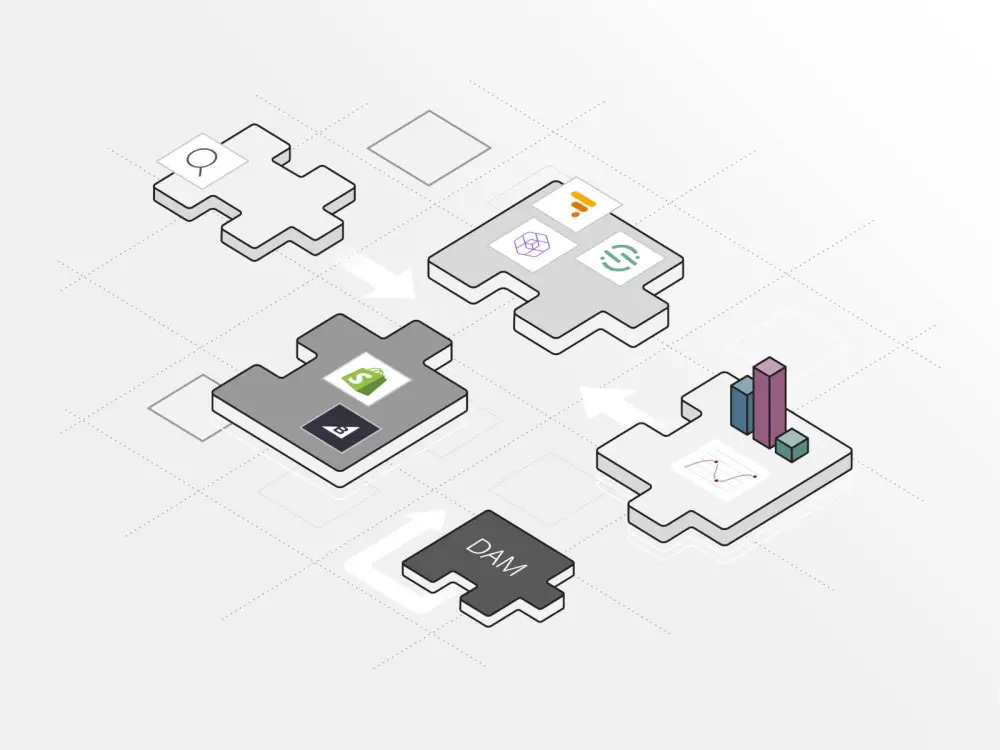
Sitecore has shifted toward a composable architecture, breaking its historically monolithic platform into modular products that organizations assemble into a stack. Each component requires its own implementation, and integrating them into a coherent platform demands significant technical investment and ongoing governance to maintain.
Editorial experience
Brightspot’s editorial interface is built for content teams, with drag-and-drop workflows, inline editing, customizable dashboards and 100+ pre-built content types. Editorial teams can create, manage and publish content independently.
Sitecore’s editorial experience has a steep learning curve that typically requires formal training and ongoing developer support to navigate. Teams migrating from simpler platforms often find the adjustment significant.
Developer experience
Brightspot gives developers a well-documented, extensible framework to build on (API-first foundation with robust data modeling tools, a Java-based framework and a GraphQL and REST API layer), but the platform is designed so that most day-to-day publishing tasks don’t require their assistance.
Sitecore offers deep developer capability, and its product suite gives experienced engineers significant control over how each layer of the stack is built and connected. The trade-off is that Sitecore development is highly specialized.
AI capabilities
Brightspot’s AI features are embedded directly into the editorial workflow: automated tagging, content recommendations, AI-assisted writing and image management live inside the interface content teams use every day.
Sitecore’s AI capabilities are delivered primarily through an add-on generative AI layer that sits across its product suite, offering potential for personalization and content intelligence at scale.
Speed to market
Brightspot is designed to reduce the gap between contract and go-live. Pre-built content types, out-of-the-box editorial tools and a managed services model mean teams can start publishing in weeks rather than months, without a large custom build preceding every launch.
Sitecore implementations involve composable architecture, specialist developer requirements and connecting multiple products into a working platform, which can create long deployment timelines.
Time to value
Brightspot’s out-of-the-box functionality means editorial teams can start working in the platform early in the implementation, reducing the lag between deployment and business value.
Sitecore’s capability ceiling is high, but reaching it requires an investment into time, budget and resources.
Scalability
Brightspot scales across content volume, site count and team size without requiring a platform rebuild and without proportionally growing your technical overhead.
Sitecore scales well for organizations that have the engineering capacity to manage it.
Total cost of ownership
Brightspot’s pricing model is predictable: licensing, managed services and implementation costs are consolidated, with extensive out-of-the-box functionality reducing the need for costly custom development.
Sitecore’s total cost of ownership (TCO) is a common reason organizations start looking for alternatives. High licensing fees, the cost of assembling and maintaining a composable product suite, specialist developer requirements and expensive upgrade cycles become expensive quickly.
When to choose Brightspot
- You manage multiple sites or brands
- You need editorial workflows and governance built in
- You need to go to market without a long development runway
- You prefer a platform that handles publishing, integrations and customization in one place
When to choose Sitecore
- You have a large, dedicated technical team with Sitecore-specific expertise
- You need deep, suite-native personalization and marketing automation at enterprise scale
- You’re already invested in a .NET ecosystem
- You have the budget, timeline and engineering capacity to implement and maintain a composable DXP
Brightspot vs. Sitecore: Cost
- With Brightspot: Brightspot offers a lower total cost of ownership with no upfront licensing fees and extensive out-of-the-box functionality, reducing the need for costly customizations. Its scalable pricing model ensures cost-effectiveness for businesses of all sizes.
- With Sitecore: Sitecore’s high licensing fees and additional costs for add-ons and support significantly increase the total cost of ownership. The platform’s complexity often necessitates significant investment in development and maintenance, straining budgets.
Migrating from Sitecore to Brightspot
The shift from Sitecore to Brightspot happens when:
- The total cost of ownership has grown beyond justification.
- Implementation and upgrade cycles are consuming too many engineering resources.
- Editorial teams are still dependent on developers for day-to-day publishing tasks.
- The complexity of managing a composable DXP outpaces capacity to govern it effectively.

We had six different CMS solutions, from WordPress to Sitecore to homegrown CMSs, and each of these were in varying states of maturity. The situation was very similar with paywall, we were using five different ones. So, very high maintenance costs, and a significant burden on operations.
Brightspot vs. Sitecore: FAQs
Brightspot tends to be the stronger fit for organizations that need enterprise-grade capability without the implementation complexity and cost that comes with a full DXP. Sitecore tends to be better suited for large organizations with dedicated technical teams, deep personalization requirements and the budget to match.
Yes, Brightspot is designed so that editorial teams can manage day-to-day publishing without needing to involve a developer.
The most common triggers are total cost of ownership, implementation complexity and editorial friction.
Sitecore’s licensing fees are high, and the cost of implementation, specialist developers, add-on products and upgrade cycles can push TCO beyond initial projections. Brightspot’s pricing is more consolidated and predictable over time.
Brightspot is built for organizations that need to scale content operations across multiple sites, teams and brands without proportionally scaling their technical overhead. Sitecore can scale to significant complexity but doing so requires scaling the engineering investment alongside it.
Find the right fit: Compare Brightspot to your current CMS
The right CMS is the one your team can use, maintain and grow with over time. If that doesn’t ring true with your current CMS, it’s time to consider alternatives.
Our team can help you assess your options and determine whether Brightspot is a good fit for your needs.