Brightspot and Acquia both target enterprise organizations with complex content and digital experience requirements, but the technical investment required to get there — and how much of that investment compounds over time — varies.
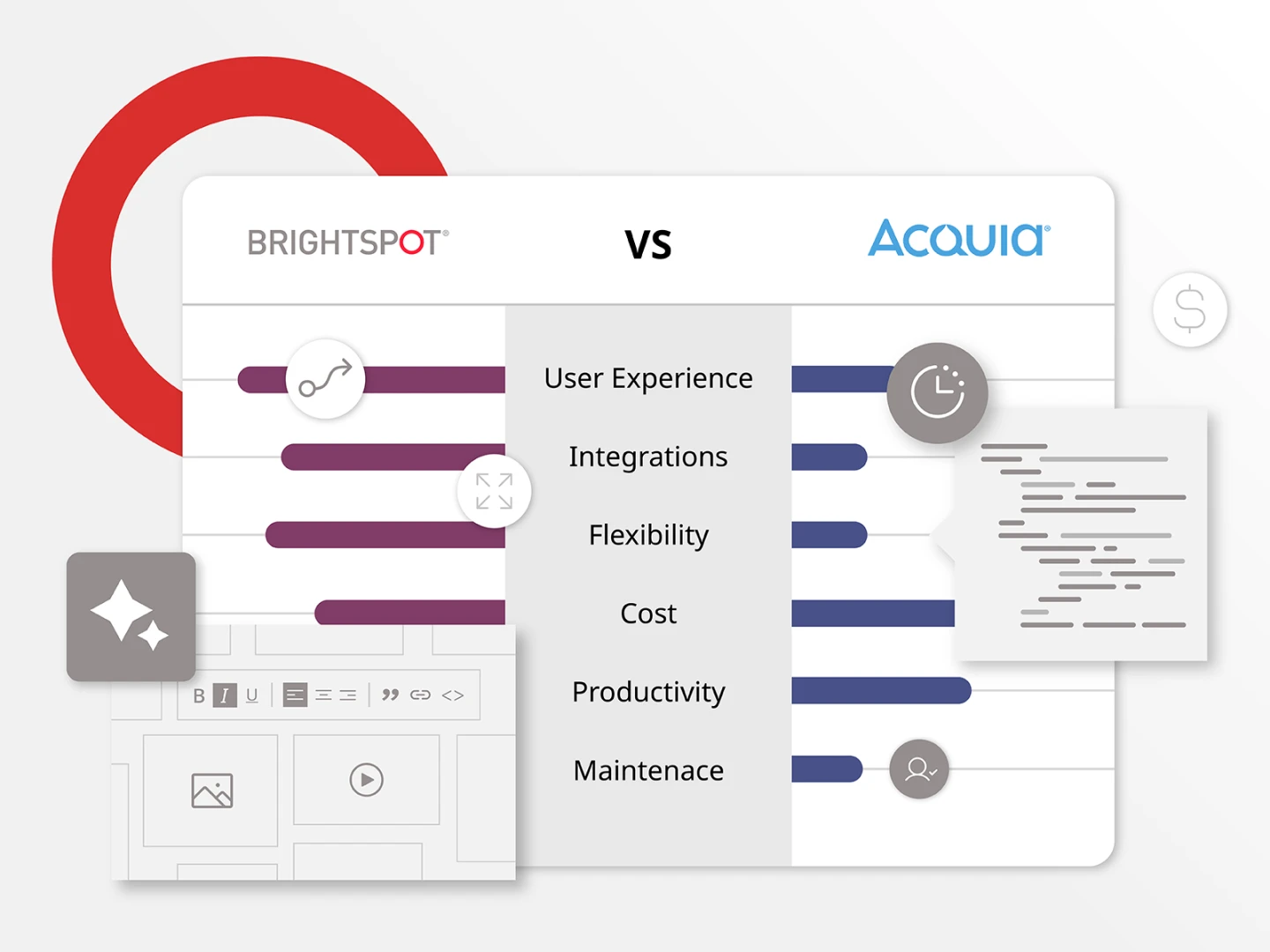
Here’s a breakdown of Brightspot vs. Acquia across architecture, editorial experience, developer overhead, total cost of ownership and more, so you can evaluate which platform is the right fit for your organization’s needs.
- Brightspot removes the build burden. Brightspot ships with a full editorial interface, preconfigured content types, native multisite management, and flexible API delivery that works out of the box. Acquia inherits Drupal’s fundamental characteristic; almost everything that makes it useful at enterprise scale has to be built, configured and maintained by a specialized development team before it delivers value to content teams.
- Content teams operate faster and more independently on Brightspot. Brightspot is purpose-built for editorial teams to publish, manage workflows and govern content without developer involvement for routine tasks. Acquia’s editorial experience requires substantial configuration to be usable for non-technical users.
- Brightspot grows with your organization without growing in complexity. Brightspot absorbs new sites, markets and content requirements without proportionally increasing engineering resources. Additions to an Acquia deployment tend to add to the custom code, module dependencies and maintenance burden that compounds over time.
- The long-term cost is clearer with Brightspot. Brightspot consolidates licensing, managed services and security into a predictable model. Acquia’s upfront cost advantage erodes once specialist developer costs, custom module development, security patching and Drupal version upgrades are factored in.
Brightspot vs. Acquia: At a glance
Looking for a CMS platform that can handle complex content operations at scale?
Brightspot takes a hybrid approach, combining headless API delivery with a full editorial interface, 100+ preconfigured content types, native multisite management, and enterprise capabilities that work out of the box. It’s built for organizations that need technical flexibility and editorial power without relying on a large specialist development team to configure and maintain the platform day to day.
Acquia is a managed cloud platform built on Drupal, with strong open-source roots and deep customization potential for organizations with experienced development teams. For enterprises already invested in the Drupal ecosystem, Acquia provides a capable managed environment, but its underlying complexity tends to require ongoing development investment.
Brightspot vs. Acquia: Feature comparison
| Feature | Brightspot | Acquia |
|---|---|---|
| Architecture | Hybrid (headless + traditional) | Drupal-based, open-source |
| Editorial experience | Built-in, robust UI | Functional, requires Drupal configuration |
| Developer flexibility | High | Very high |
| AI capabilities | Embedded into editorial workflow | Available via modules, requires configuration |
| Multisite/multi-brand | Native support | Available, complex configuration |
| Workflow management | Built-in | Module-dependent |
| Personalization | Integrated | Requires custom development |
| Implementation speed | Faster out of the box | Slow, requires significant custom build |
| Total cost of ownership | Predictable | Can escalate with dev and licensing needs |
Brightspot vs. Acquia: Key differences
Architecture
Brightspot supports headless, decoupled or hybrid delivery from a single environment, with flexible content modeling, a full editorial interface and preconfigured content types that give both developers and content teams a working foundation from day one — all without a custom build phase preceding it.
Acquia provides a managed cloud environment built on Drupal, with API capabilities and extensibility that the Drupal ecosystem offers. For organizations with experienced Drupal development teams, that foundation can support sophisticated content architectures and complex digital experience requirements. However, almost everything that makes it useful at enterprise scale has to be built, configured and maintained by developers before it delivers value to content teams.
Editorial experience
Brightspot’s editorial interface is built around the needs of content teams, with an intuitive authoring environment, structured content types, collaborative workflows, built-in preview and customizable dashboards that non-technical users can work in from day one without requiring developer involvement for routine publishing tasks.
Acquia’s editorial experience is inherited from Drupal, which means it’s functional but demanding. The authoring interface requires significant configuration before it works well for non-technical users, and content teams typically face a steep learning curve even after a thorough implementation.
Developer experience
Brightspot gives development teams a well-documented, extensible Java-based framework with GraphQL and REST APIs and auto-generated API support. It’s designed so that engineering capacity isn’t consumed by the routine publishing and configuration tasks that content teams can handle independently.
Acquia offers developers the full depth of the Drupal ecosystem: a large open-source community, extensive documentation and significant customization capability for teams with the right expertise. Acquia development is highly specialized and resource-intensive, requiring ongoing developer involvement.
AI capabilities
Brightspot’s AI features are woven directly into the editorial workflow — automated tagging, AI-assisted writing, content recommendations and smart image management are available to content teams inside the platform they already use, without additional configuration or third-party setup standing between editors and the tools that help them work faster.
Acquia’s AI capabilities are largely dependent on the Drupal module ecosystem and custom integrations. There is no native AI layer embedded in the editorial experience, and surfacing AI assistance for content teams requires building and maintaining the integration separately.
Speed to market
Brightspot’s combination of preconfigured content types, ready-to-use integrations and a fully operational editorial interface means organizations can move from platform selection to active publishing without a lengthy build phase. Content teams have what they need to start working from day one.
As a managed Drupal platform, almost everything required to make Acquia operational for content teams — content types, workflows, editorial interfaces and integrations — has to be built or configured before publishing can begin.
Time to value
Brightspot is built to close the gap between contract and productivity. Its full editorial interface, preconfigured content types and plug-and-play integrations available from the start allow content teams to begin doing real work early in the implementation.
Acquia’s time to value is gated behind the development work required to stand the platform up.
Scalability
Brightspot absorbs organizational growth without requiring a proportional increase in technical resources. Native multisite management, localization and workflow governance mean that new sites, brands, markets and content requirements can be added from a single platform instance without each addition becoming a development project.
Acquia scales well for organizations with the engineering capacity to support it, but development investment scales alongside it: every new site, content model, or integration requirement adds to the custom code, module dependencies and maintenance burden that has to be managed over time.
Total cost of ownership
Brightspot consolidates licensing, managed services, implementation support and security into a predictable model. Its extensive out-of-the-box functionality reduces the custom development required to get the platform operational, so organizations spend less on standing it up and less on maintaining it as requirements evolve over time.
The specialist Drupal development required to build and maintain an enterprise Acquia deployment, the ongoing module updates and security patching, the cost of major Drupal version upgrades and the expense of retaining or contracting the expertise needed to keep the platform current all influence a higher TCO.
When to choose Brightspot
- You need enterprise-grade content operations without development overhead.
- You want editorial workflows, content types and governance built into the platform, not assembled through module configuration and custom development.
- You manage multiple sites, brands or markets and need native multisite support from a single platform instance without a proportional increase in technical resources.
- You need predictable costs and a platform that doesn’t require a growing specialist development practice to stay operational as your organization scales.
When to choose Acquia
- You have a large, experienced Drupal development team with the capacity to build and maintain a fully custom implementation.
- Your organization is deeply invested in the Drupal ecosystem and the cost of replatforming outweighs the limitations of your current setup.
- Your use case requires the deep, bespoke content architecture and open-source flexibility that Drupal’s ecosystem provides.
Migrating from Acquia to Brightspot
Organizations choose Brightspot over Acquia when:
- The ongoing cost of maintaining a specialist Drupal development practice has grown beyond what the platform’s value justifies.
- Editorial teams remain dependent on developer support for day-to-day publishing tasks despite significant platform investment.
- Major Drupal version upgrades feel like full re-implementations rather than straightforward migrations.
- The organization needs to scale its digital footprint without proportionally scaling its development team.
Brightspot vs. Acquia: FAQs
Understanding the differences between Brightspot and Acquia
Brightspot works well for organizations that need enterprise-grade content operations without the development overhead that Acquia’s Drupal-based platform requires. Acquia works well for organizations with experienced Drupal development teams and the capacity to build and maintain a fully custom implementation.
Brightspot is designed so that editorial teams can publish content, manage workflows and configure the platform independently. Tasks that require module configuration or custom development in Acquia are handled natively in Brightspot.
The most common triggers are editorial friction, compounding development costs and the overhead of major Drupal version upgrades.
Brightspot’s pricing is more consolidated and predictable over time. Acquia’s open-source licensing can look cost-effective upfront, but factors like specialist developer costs, custom module development, security patching and upgrade cycles frequently push TCO higher.
Brightspot’s out-of-the-box functionality, managed services model and built-in editorial tools reduce the ongoing development required to keep the platform operational. Acquia’s module-dependent architecture means that maintenance, updates and new requirements consistently demand developer involvement.
Find the right fit: Compare Brightspot to your current CMS
Whether you’re actively evaluating alternatives to Acquia or simply questioning whether your current platform is worth what it costs to maintain, it’s worth understanding what a modern enterprise CMS looks like in practice.
Connect with a Brightspot expert to discuss your organization’s specific requirements for your next CMS.

Discover what’s possible with Brightspot
- See why Brightspot is the most flexible CMS to deliver content at scale
- Discover how to create, edit and launch content with speed & ease
- Meet our team of experts here to support you each step of the way