- Starting an enterprise CMS evaluation with a vendor shortlist gets the process backwards; the shortlist is what a good evaluation produces.
- AI engines and analyst reports return the same five or six platform names regardless of what your organization actually needs, making visibility a poor proxy for fit.
- Feature comparisons introduced too early waste time because every mature CMS can check the same boxes at the demo stage.
- Governance complexity is the most underweighted criterion — and the hardest to map — because it requires internal alignment across editorial, legal, IT and regional teams before you can even frame the question for a vendor.
- Excluding editorial teams from early evaluation conversations creates blind spots that surface post-launch as weak adoption and low velocity.
- Deployment and data sovereignty requirements are often hard constraints driven by compliance or IT policy, not preferences — making them the most efficient filter in the framework.
- Optimizing for the lowest license fee frequently leads to higher long-term costs through expensive specialist developers, limited implementation partners and painful upgrade cycles.
Right now, ask Claude which enterprise CMS platforms you should evaluate. We’re willing to bet it’ll return the same five or six names regardless of what your org actually needs. Analyst reports return the same list. So does peer benchmarking.
If that’s how you research and discover CMS options, you’ve got it all backwards. The shortlist isn’t the beginning of an evaluation; it’s what a good evaluation produces.
Orgs that build their CMS shortlist by first articulating their critical requirements end up with a much shorter and more relevant list in the near term, and fewer regrets at the 18-month mark post-implementation.
We talked with Tiho Cheresharski, Brightspot’s Senior Director of Solutions Engineering, and Amelia Bragg, Brightspot Program Manager, about what enterprises consistently get wrong when picking a CMS vendor.
The roadmap of the product and the customer voice in it is the true indicator of a customer-centric product that solves real challenges versus one that just adheres to trends.
From that, we’ve put our finger on five enterprise CMS evaluation criteria that’ll narrow your search before you start booking demos.
The shortlist has become a default, not a decision.
Well-known platforms like WordPress, Contentful and Drupal will always show up first when you ask AI what’s worth considering. The list gets reinforced every time someone runs a Google search, reads a Gartner report, or asks someone else what they’re evaluating.
So visibility becomes a proxy for fit, and by the time a steering committee assembles, the RFP shortlist feels like a given rather than a choice. The issue is that “great online presence” doesn’t equal “great fit for your company.”
Feature comparisons come too early (and cost too much time).
Every enterprise CMS can handle multisite, localization and headless delivery. Those aren’t differentiators. So, when feature checklists precede the criteria evaluation, every platform looks equally capable because at the demo stage, they essentially are.
The real divergence happens at the edges — how a platform handles your specific governance structure and whether it fits your deployment constraints. Undefined priorities at this stage carry a cost.
“Often we see prospects’ priorities not clearly defined in the beginning,” says Tiho. “We see mid-evaluation prospects go back to the drawing board and start questioning what’s actually needed.” By the time that happens, vendors have already presented and POCs are underway, so the cost of resetting is significant.
He also flags another consequence of jumping to features too early: companies get drawn in by a platform that solves one specific problem, without asking what happens beyond that. “You end up in a situation with a large number of vendors and a tech sprawl which comes back to haunt them,” he says. “Then comes the cycles of consolidation — a painful process that could have been avoided with enough future-proofing.”


The “Fit Before Feature” framework: 5 CMS evaluation criteria for modern enterprises
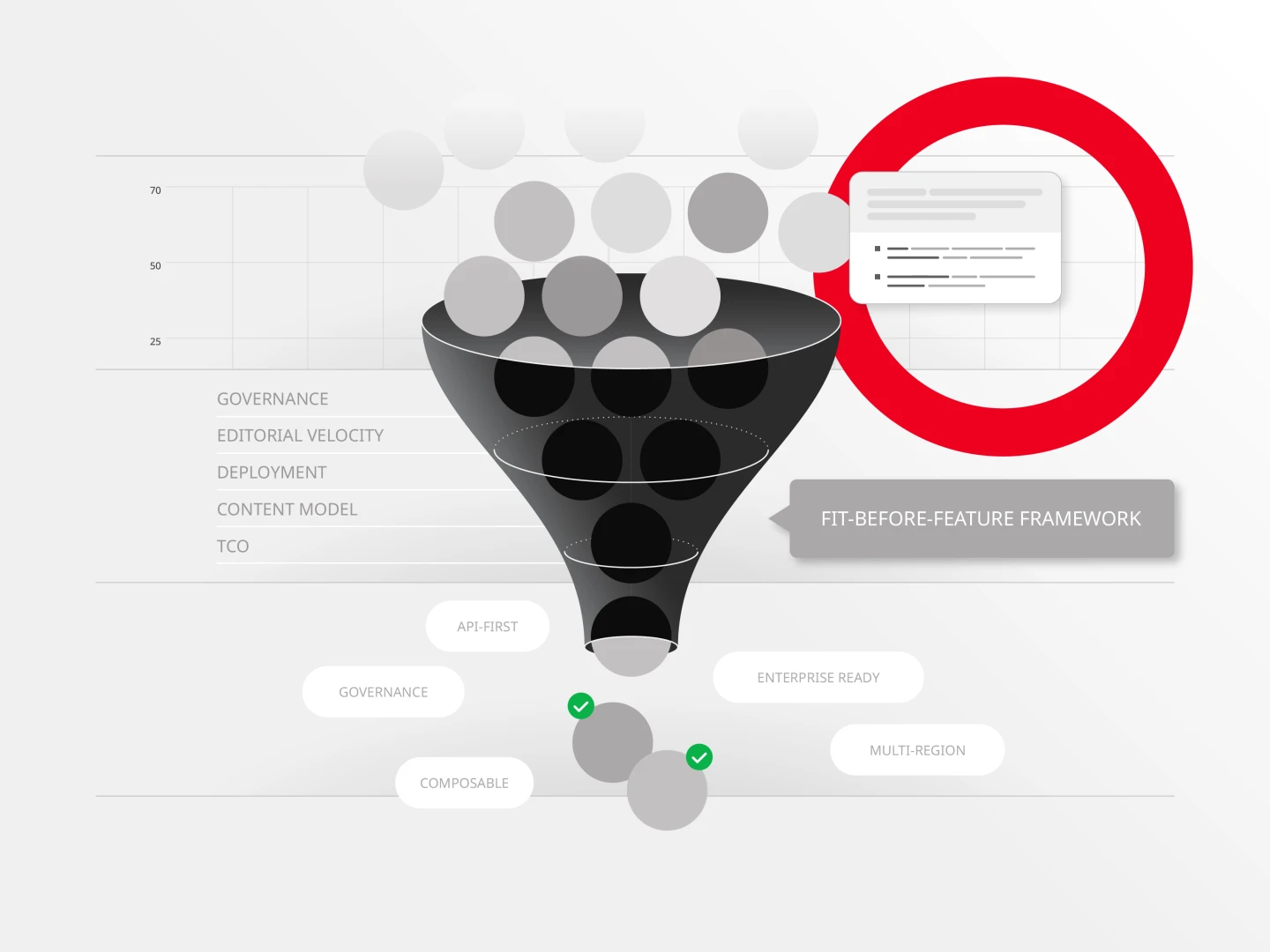
The fix is a process that flips this order. Let’s call it the Fit-Before-Feature framework; e.g., the five criteria for enterprise content management system selection, based on the operational realities of your business:
Governance complexity
Governance complexity covers the full scope of how your organization creates, approves and publishes content. That includes editorial roles, approval stages, compliance requirements, regional permissions and brand controls across every team that touches the content management system (CMS).
Governance complexity is the one that stands out to me. It requires very deep understanding of one’s own operation and future needs, and it’s often overlooked or not well understood by the system evaluator.
When we asked Tiho which of the five criteria enterprises underweight most in their CMS RFP criteria, he didn’t hesitate. “Governance complexity is the one that stands out to me,” he says. “It requires very deep understanding of one’s own operation and future needs, and it’s often overlooked or not well understood by the system evaluator.”
The reason it gets skipped — or treated superficially — is that it’s genuinely hard to do. Mapping your governance structure requires internal alignment across editorial, legal, IT and regional teams before you can even frame the question for a vendor. TCO is easier to quantify, so it gets prioritized.

Editorial team velocity
Editorial team velocity describes how many people are publishing content, how often, across how many sites or channels, and what their daily workflow looks like. A platform that works beautifully for a five-person editorial team could easily become a bottleneck for 50.
By understanding not only how your editorial team currently works, but how they want to work and what is possible for them, you can lead the conversation effectively and deliver a solution that will increase your team’s velocity.
Amelia Bragg, Brightspot Program Manager, sees this as the criterion most likely to determine whether an implementation succeeds or fails at the 12-18 month mark. “I see a lot of organizations that wait to bring in their editorial team into the conversation, but don’t truly know what the people who will be the daily users care about,” she says.
Editorial teams have a day job and they can’t be in every evaluation meeting. Excluding them early creates a blind spot that shows up post-launch as weak adoption. “By understanding not only how your editorial team currently works, but how they want to work and what is possible for them, you can lead the conversation effectively and deliver a solution that will increase your team’s velocity,” Amelia adds.
Deployment and data sovereignty
Where does your content infrastructure live? Who’s able to access it? What regulatory constraints govern that? Cloud-only, hybrid, on-premise, regulated cloud — the answer might not be a preference. It’s often a hard requirement driven by legal, compliance or IT policy.
This criterion is the most efficient filter in the entire framework. If you’re operating under strict data residency requirements (e.g., in financial services or healthcare) you can rule out platforms the moment you ask where data is stored and who holds the keys.

Content model requirements
A headless CMS can deliver content to any channel via API; a traditional coupled CMS can’t. A structured content model built around reusable components scales across dozens of sites; a page-based model doesn’t.
Ask how your content is structured, stored and delivered across every channel your organization operates.
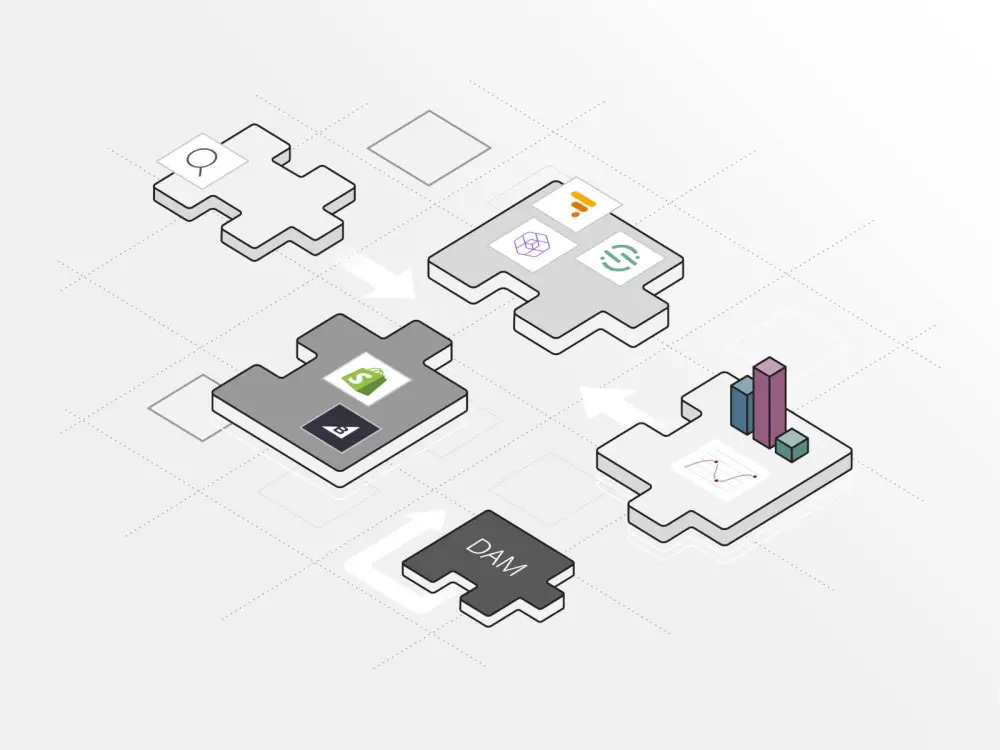
This is also where you think about composability. If your content needs to reach multiple channels beyond a primary website, if your development team needs the flexibility to build custom front-end experiences, or if your tech stack already includes best-of-breed tools you’re not willing to rip out, a monolithic platform that bundles everything together will create constraints — even if it looks simpler on the surface.

Total cost of ownership
License fees are one input. The real TCO number includes implementation partner costs, developer availability and specialization, upgrade cadences, ongoing support and the internal resources you’ll need to maintain and extend the platform over time.
This is the criterion Tiho flags as the one that gets over-prioritized, but in the wrong way. “Often, TCO is prioritized beyond everything else,” he says, “and inevitably people pay the price by dealing with sub-optimal operational efficiency.”
Organizations optimize for the lowest license fee and end up with a platform that requires expensive specialist developers, a limited implementation partner ecosystem, or a painful annual upgrade cycle that consumes engineering bandwidth every year.


A shorter shortlist is a better shortlist
Arrive at two or three platforms that are genuinely worth your time and evaluate those seriously. That shift alone cuts weeks of wasted demo cycles and keeps internal stakeholders from hitting decision fatigue.
Tiho also flags something worth building into the shortlist phase that most organizations skip entirely. “I wish more buyers asked about the product roadmap and how it has historically evolved,” he says.
“The roadmap of the product and the customer voice in it is the true indicator of a customer-centric product that solves real challenges versus one that just adheres to trends.” Once your criteria have narrowed the field, that’s the question to put to the platforms that made the cut.
CMS evaluation requires internal alignment, not just vendor comparison
Questions like “who owns governance?” and “what does our content model need to do?” are organizational. The organizations getting enterprise CMS decisions right in 2026 treat evaluation as an internal alignment exercise first and a vendor selection process second. Get your criteria right, and the vendor selection follows.
Once your criteria are defined and your shortlist is down to two or three viable platforms, the next step is a formal RFP. Our guide to creating a CMS RFP covers how to structure one, what to ask and how to keep the process moving.
If you’ve defined your criteria and are ready to see how Brightspot measures up against them, the best next step is a conversation rather than a demo checklist. Talk to our team.
Three, ideally. Two or three platforms that genuinely meet your criteria is a better outcome than seven assembled from an analyst report. If your shortlist has more than four or five platforms on it, your evaluation criteria aren’t defined tightly enough yet.
A CMS evaluation is the internal process of defining your requirements and narrowing the field. A CMS request for proposal (RFP) is the formal document you send to shortlisted vendors to solicit structured responses against those requirements.
A CMS evaluation comes before the RFP because you need to know which vendors to prioritize based on your selection criteria. An RFP sent before you’ve done that internal work generates a lot of vendor responses you’re not equipped to compare.
It depends on the organization, but the ideal enterprise CMS evaluation timeline is somewhere between 3 and 6 months from the initial kickoff to vendor decision. That’s enough time to align everyone, evaluate vendors and build proof-of-concepts.
The biggest driver of overly long timelines is internal decision-making.
“Often there is lack of clarity on the internal steps needed for the evaluation,” says Tiho Cheresharski, Brightspot’s Senior Director of Solutions Engineering.
Defining your criteria and internal process upfront, before vendor outreach begins, is the single biggest lever for keeping the timeline within that 3-to-6-month range.
The criteria that matter for CMS selection at the Fortune 500 scale are governance complexity, editorial team velocity, deployment and data sovereignty, content model requirements and total cost of ownership. These determine whether a platform actually fits how a particular organization operates.