Key takeaways:
- Your CMS sets the ceiling for how machine-readable your content can become, which directly limits your AI visibility.
- LLM SEO goes beyond traditional optimization to require structured content types, entity relationships and machine-readable provenance.
- Six platform features separate AI-ready CMSes from the rest: structured content modeling, broad schema.org support, API-first delivery, content modularity, freshness signals and editorial governance.
- Headless and API-first architectures have a structural advantage for LLM ingestion over platforms built around single rich-text fields.
- Editorial workflow and governance are often overlooked in AI-readiness discussions, but they determine whether structured data stays clean at scale.
- The article includes a self-scoring audit framework teams can use to benchmark their current or prospective CMS against six AI-readiness criteria.
A few years ago, choosing a CMS was a decision about how your team would publish. Today it’s also a decision about whether anyone outside Google will find what you publish.
“The rise of AI has turned the SEO world on its head,” remarks Brightspot’s Miles De Feyter, Senior Director of Creative Services and expert SEO adviser to Brightspot’s CMS customers. “Publishers now need the flexibility to adapt quickly, and the CMS has become a critical part of that equation. The platforms that make content easier to structure, optimize, and evolve are the ones helping publishers stay visible in the age of LLMs and generative search.”
ChatGPT, Perplexity, Gemini and Claude have started answering the questions readers used to type into a search bar. When they cite a source, that source has usually been ingested in a particular way: as clean, structured content with clear semantic signals. The platforms that surface in AI answers share a set of traits. The platforms that don’t, share another set.
This guide looks at seven CMS platforms through the lens of LLM SEO — the practice of preparing content so that large language models can read, understand and cite it. The criteria are the same ones AI crawlers actually use: schema support, content model clarity, API access, freshness signals and metadata depth.
The rise of LLMs and generative engine optimization has fundamentally reshaped the SEO landscape, and adaptable CMS platforms are giving publishers the ability to pivot quickly, structure content more intelligently, and stay visible as search continues to evolve.
What LLM SEO means and why your CMS choice matters
LLM SEO — increasingly referred to as Generative Engine Optimization, or GEO — is the discipline of structuring content so that AI answer engines can ingest, understand and cite it accurately. It overlaps with traditional SEO (equaling clean HTML, good metadata, sensible site architecture, quality content), but adds new requirements: explicit entity relationships, schema.org coverage that goes beyond Article, content broken into self-contained answer units and machine-readable provenance.
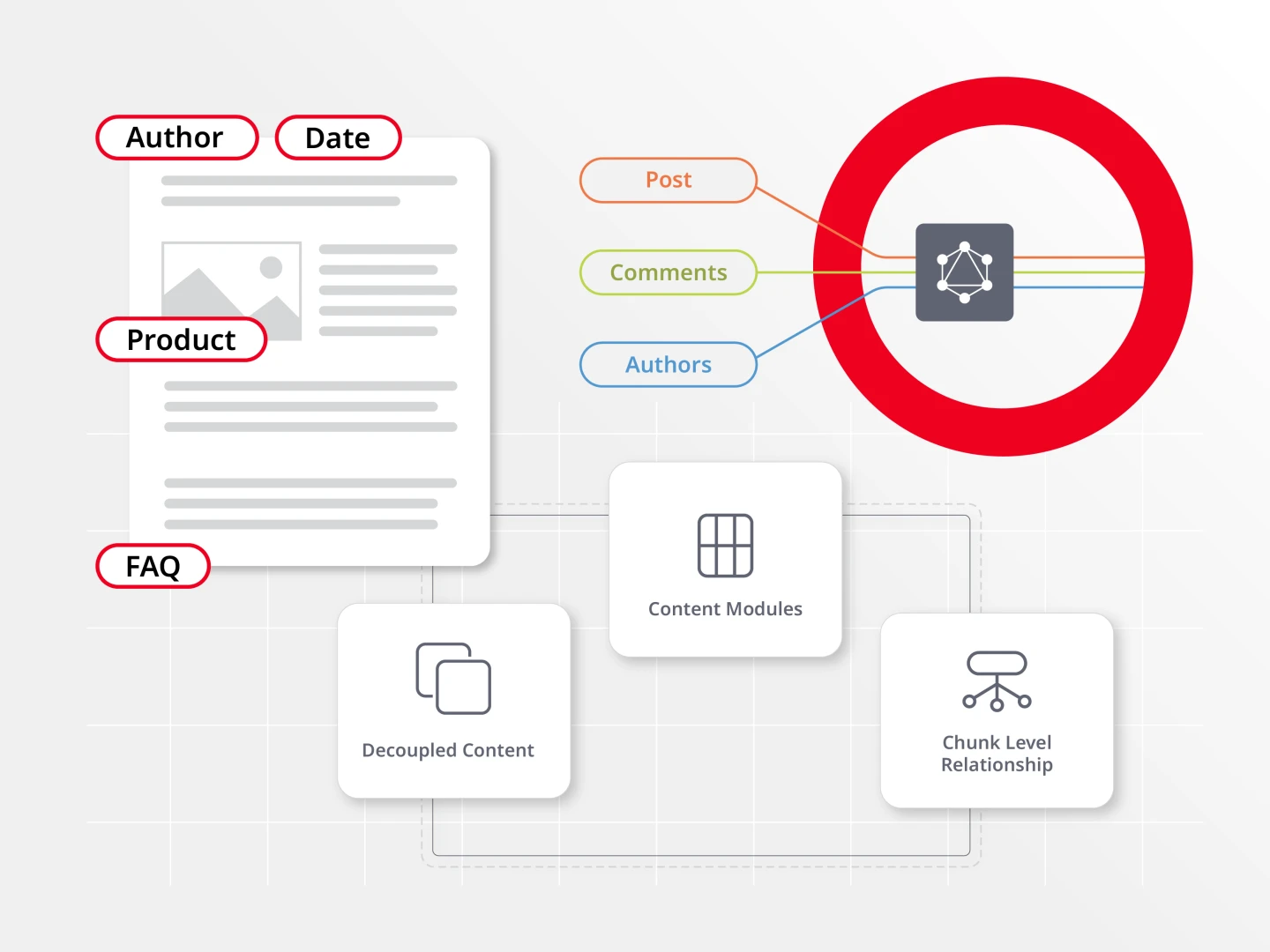
Most of these are CMS-level concerns. A great writer can’t add JSON-LD that the platform doesn’t support. An editor can’t restructure content into AI-friendly chunks if the content model only has a single rich-text field.
“The CMS sets the ceiling for how machine-readable your content can become, which means it sets the ceiling for AI visibility,” observes Miles De Feyter.
For organizations evaluating their stack, this changes the buying criteria. Page-builder convenience and theme libraries matter less. Content modeling, API surface area and structured data flexibility matter more.

Every tool your team needs, in one browser extension
The CMS features that drive AI discoverability
ChatGPT, Perplexity and Google’s AI Overviews are answering questions directly now. If your content isn’t the source behind those answers, you’re invisible to a growing share of your buyers.
So how do you evaluate if your CMS is LLM-ready?
Structured data and clean markup accomplish nothing if the crawler responsible for surfacing a page was never allowed to reach it in the first place. Comparison charts rarely mention this, but crawler accessibility is quickly becoming its own AI-readiness criterion in its own right, distinct from schema support or content modeling.
AI models pull discrete answers out of a page, not the whole article.
“If a crawler can’t read it, it can’t cite it,” says Caleb Popelka, Marketing Operations at Brightspot. It is a simple standard, but an unforgiving one. A page with perfect schema markup and a well-modeled content type still produces nothing if access was blocked upstream.
Freshness signals do more work in AI search than they ever did in traditional SEO. Where a search engine might tolerate an older page if it still ranks well on relevance, AI answer engines use recency as a proxy for trust, and they weight it heavily when deciding which sources to surface in a generated answer.

What GEO actually asks of your CMS
“AI systems weight recency heavily when deciding what to trust,” notes Popelka. “If you’re not re-timestamping your highest-value pages, you’re telling those systems your content might be stale.” A CMS that makes it simple to update and re-timestamp high-value pages, without requiring a full republish, gives editorial teams a lightweight way to keep their most-cited assets current.
Page speed and reliability round out the list for a simpler reason: slower, less dependable sources get cited less by AI answer engines, regardless of how well-structured or well-written the underlying content is. Speed is not a ranking nicety here, it is a precondition for being considered at all.
None of this is theoretical. Brightspot applies this same eight-factor framework to its own content, and the results show up directly in AI search results. “Brightspot already holds a 96-citation foothold for ‘best CMS’ queries in LLM search results,” says Popelka, “because we build our own content the same way we’re telling you to build yours.” That is the practical test for any of the criteria above: not whether a platform can check the box in a comparison chart, but whether it produces content AI systems actually choose to cite.
The CMS features that drive AI discoverability

Structured content modeling

Schema.org support beyond the basics

API-first delivery

Content reuse and modularity

Freshness and revision signals

Crawler accessibility

Page speed and reliability

Editorial governance
Platforms that handle all eight show up in AI answers. Platforms that handle two or three leak visibility.

The 7 best CMS platforms for LLM SEO compared
Brightspot
Brightspot was built around structured content from the start, which is what makes it well-suited to LLM ingestion in 2026. Every content type is defined as a set of typed fields. Every field is addressable through the GraphQL API. Schema markup is supported across the major content types. Editors get a familiar in-context authoring experience; developers get a fully decoupled delivery layer when they need it.
For enterprise media, publishing and corporate brands, the combination matters: rich content modeling that doesn’t punish the editors who work in it every day. Brightspot also handles the operational pieces that often get overlooked in AI-readiness conversations: workflow, versioning, taxonomies and content audit trails. Those are what keep structured data clean as a content library grows past a few thousand items.
WordPress VIP
WordPress powers a meaningful share of the open web, and the VIP tier brings enterprise-grade hosting, performance and security to it. For AI discoverability, VIP improves on self-hosted WordPress in three ways. The REST and GraphQL APIs are reliable. Schema support comes through well-maintained plugins. Gutenberg blocks give editors a route to structured content.
The honest limit is that WordPress’s data model is post-and-meta at its core, which makes deeply typed content modeling harder than on natively structured platforms. For brands already on VIP, the path to AI readiness runs through disciplined block usage, strong schema plugins and a clean taxonomy strategy.
Drupal
Drupal has supported structured content longer than almost any open-source CMS, and it shows. Content types, fields, taxonomies and references are native concepts, not bolted-on features. JSON, API and GraphQL modules give AI crawlers clean access to content, and Schema.org Metatag modules cover the major types.
The trade-off is operational. Drupal rewards organizations with the technical depth to run it well and punishes those that don’t. For teams with an in-house engineering function and a long content lifecycle, it remains one of the strongest AI-ready options in open source.
Contentful
Contentful is a headless CMS designed around an API-first model, which puts it on solid ground for LLM SEO. Content models are explicit and typed. The GraphQL and REST APIs are well documented. The platform integrates cleanly into modern front-end frameworks.
The work that still falls to the team is schema markup and editorial structure. Contentful gives you the pipes; the structured data and content shape are yours to define. Best fit for product-led brands and digital teams that want to compose their stack and have the engineering capacity to do so.
Sanity
Sanity treats content as data more literally than most platforms, with its schema-as-code approach and the GROQ query language. For AI ingestion, that’s a strength: content models are tightly typed, queries return clean structured payloads and the real-time API makes freshness easy to surface.
Portable Text gives you componentized content that breaks down well into AI-friendly chunks. Sanity sits best with engineering-led teams comfortable defining schemas in code, and less naturally with editorial teams looking for a polished out-of-the-box authoring experience.
Strapi
Strapi is open-source, headless and self-hostable, which makes it a common pick for teams that want control over their stack. Content modeling is straightforward, the REST and GraphQL APIs are first-class and the plugin ecosystem covers schema markup and SEO needs.
The AI-readiness story depends heavily on how the implementation is configured. A well-modeled Strapi instance can rival commercial headless platforms; a poorly modeled one inherits the same problems as any free-text CMS. Suits teams with the engineering resources to build and maintain it.
Sitecore
Sitecore has been an enterprise CMS staple for two decades, and its more recent composable platform brings headless delivery and structured content into the core experience. XM Cloud exposes content through GraphQL, supports flexible content modeling and integrates with the wider Sitecore personalization and analytics stack.
The trade-offs are familiar. It’s a heavyweight platform that expects a corresponding investment in implementation and operations. For large enterprises already standardized on Sitecore, the path to AI readiness is one of configuration rather than migration.
Compare Brightspot CMS vs. Sitecore here
How to evaluate a CMS for AI-ready content operations
The CMS sets the ceiling for how machine-readable your content can become, which means it sets the ceiling for AI visibility.
Most platform evaluations get derailed by feature checklists. For AI readiness, a shorter set of questions is more useful.
Can a non-developer create a new content type with typed fields, or does every model change require a code release? Does the platform generate schema.org markup automatically, or is it the team’s job to maintain it by hand? Is content addressable through a clean API in JSON, separate from the rendered page? Does metadata cover author, publish date, modified date and revision history without manual intervention? Does the editorial workflow protect structured data as content scales, or does discipline slip after the first hundred items?
The platforms that handle all five are the ones already showing up in AI citations.
AI readiness audit: Score your platform now
Run your current CMS or ones you are evaluating against the criteria below. Each one maps to a structural decision your platform either supports or doesn’t — no amount of content quality compensates for the gaps. Score 1–5, total your result, and you’ll know exactly where your AI visibility ceiling is.
| Content architecture | ||
| Content architecture | ||
| Machine readability | ||
| Machine readability | ||
| Freshness & provenance | ||
| Editorial governance |
What happens when your CMS isn’t optimized for AI search
The cost of an AI-unfriendly CMS isn’t loud. It’s a slow leak of visibility: queries that used to send traffic now get answered in-line by an AI engine, and your content isn’t the one being cited. Over 12 to 24 months, that compounds. Competitors with cleaner structured data become the default source for your category. Rebuilding from that position is harder than getting the foundations right the first time.
Future-proof your content infrastructure with Brightspot
The CMSes that do well in AI answers in 2026 share a profile: structured content at the core, strong APIs, clean schema and editorial workflow that protects the data underneath. Brightspot is built around that profile and supports the operational work that keeps a content library healthy as it scales. If your team is evaluating the next platform, or auditing the one you already run, the criteria in this guide are a sensible place to start.
Frequently asked questions: CMS & LLM SEO
The best CMS for LLM SEO is one that combines structured content modelling, clean APIs and native schema.org support with editorial workflows that keep that structure intact at scale. Brightspot, Drupal and Sanity rank highly against these criteria, with the right choice depending on team composition and content volume.
Typed content models, clean JSON APIs, comprehensive schema.org support, machine-readable freshness signals and editorial governance. Together these determine how reliably an AI engine can ingest, understand and cite your content.
Headless platforms expose content through APIs as structured data, which is closer to what AI ingestion pipelines prefer. The visibility gain isn’t automatic; it still depends on content modelling and schema discipline. But the architecture removes a common bottleneck.
WordPress can work for AI search, particularly on the VIP tier, but it takes more configuration than natively structured platforms. The post-and-meta data model puts a ceiling on how deeply typed content can become without significant custom work.
Start with structured content modelling, schema support and API access. Then look at the operational layer: workflow, taxonomies, governance and audit trails. The first set determines whether AI engines can read your content; the second determines whether that stays true past the first six months.