In the 24/7 world of digital journalism, the tools you rely on can mean the difference between being first to report or falling behind. For news publishers, a content management system (CMS) isn’t just a platform for organizing stories — it’s the backbone of a newsroom’s operation. Every feature in a CMS, from real-time publishing to scalability, plays a critical role in ensuring a newsroom stays agile and competitive. This is especially true in an era where breaking news can emerge at any moment and newsrooms must reach their audience across a wide array of platforms. Let’s explore how key CMS features are shaping modern newsrooms by diving into real-world examples of Brightspot’s projects and their impact on publishers.
At-a-glance: Features, definitions, why they matter and examples
| Feature | Definition | Why it matters | Real-world examples |
| Real-time publishing | Push updates immediately across channels | Keeps audiences informed during breaking events | NPR used low-bandwidth, real-time pages during Hurricane Milton. |
| Multi-channel publishing | Publish to web, apps, social, newsletters and feeds from one source | Reaches readers on their preferred platforms | Los Angeles Times distributes site, app, social from one CMS. |
| Collaborative editorial workflows | Role-based, auditable workflows for writers, editors, fact-checkers | Maintains speed and accuracy under pressure | Euromoney used workflows for rapid financial-event publishing. |
| AI integrations | Managed AI tools for ideation, SEO, transcripts and translation | Extends capacity and speeds repetitive tasks while preserving editorial control | SBS uses multisite features and translation support across 70 languages. |
| Version control & archiving | Track edits and retain archives for republishing and compliance | Enables safe rollbacks and content reuse | EdWeek keeps an organized, versioned content library. |
| Scalability & resilience | Auto-scaling, caching, CDN and security to handle traffic spikes | Ensures availability during major events and attacks | Brightspot sites handled 37M requests/min during an Election Night botnet attack. |
| Automated scheduling | Time-based and rule-based content release | Ensures consistent publishing when teams are offline | E.W. Scripps uses scheduling for breaking news and video across stations. |
| Personalization & targeting | Deliver content tailored to segments, regions, or behavior | Increases engagement and retention | Univision localizes homepages for U.S. vs Mexico audiences. |
| SEO tools | Built-in metadata, performance and Core Web Vitals support | Boosts organic discoverability for breaking and evergreen content | POLITICO uses CMS SEO features to improve ranking for breaking stories. |
| Analytics & real-time insights | Live metrics and integrations to inform editorial choices | Enables data-driven story and distribution decision | Caracol TV saw a 20% traffic increase in the first week after launch. |
| Monetization & paywall support | Flexible subscription and meter controls integrated with content | Balances revenue and access with dynamic controls | The Chronicle of Higher Education uses Brightspot’s dynamic paywall features. |
What is Brightspot?
Brightspot is an enterprise-level content management platform designed to help media companies navigate the complexities of today’s digital environment. It provides the flexibility, adaptability and power needed to manage and deliver content across multiple channels efficiently. Brightspot offers AI-driven productivity tools, deep integrations with all the most essential business applications and the ability to scale as your needs evolve. This makes it an ideal solution for media organizations that want to transform their content strategy and drive engagement in a fast-paced, ever-changing landscape.
How can Brightspot help media companies?
The media industry is under constant pressure to deliver more content across more platforms than ever before, all while maintaining high levels of engagement and efficiency. Brightspot addresses these challenges by providing a platform that enhances productivity, streamlines workflows and offers unmatched flexibility. With Brightspot, media companies can not only manage content more effectively but also create immersive, personalized experiences that resonate with their audiences.
By moving beyond traditional content management to deliver comprehensive content experiences, Brightspot enables media companies to maintain operational efficiency, stabilize revenue and enhance audience engagement—all while confidently embracing AI-driven innovations.
Brightspot has unleashed tons of creativity in our newsroom. Our overall agility has skyrocketed because so many things that used to require code now just take a couple of clicks. We can now tell stories and enrich our readers’ lives in so many ways we couldn’t previously.
Real-time publishing: Deliver breaking updates instantly
Definition:
A low-latency publishing path that pushes updates to CDN, apps, social feeds, and text-only fallbacks within seconds of publication.

The flexibility has been huge — especially during severe weather. We can make changes quickly without everything grinding to a halt.
Why it’s essential:
- Ensures readers receive the latest information during breaking events.
- Protects trust and traffic by minimizing stale or conflicting updates.
Measurable success criteria:
- End-to-edge latency target: <5 seconds for editorial updates to CDN edge in normal conditions.
- Support atomic publish/unpublish operations and minimal reconciliation delays.
- Provide low-bandwidth “text-only” renderings and AMP/fast pages for constrained networks.
Example:
NPR used real-time and text-only pages to deliver updates during Hurricane Milton. (Read the NPR case study below.)

Multi-channel publishing: Distribute content everywhere from one source
Definition:
Central content authoring with outputs to web, mobile apps, social posts, RSS, newsletters, and syndication APIs.

Our goal is to provide actionable, high-quality, news, data and analysis to professionals across multiple industry segments and through relevant brands. Brightspot’s central, extensible solution is helping us succeed.
Why it’s essential:
- Reduces duplicate work and preserves consistent messaging across platforms.
- Maximizes reach by meeting audiences on their preferred channels.
Measurable success criteria:
- Support native export formats (JSON, RSS, AMP, app payloads, OpenGraph/Twitter cards).
- Provide templating and channel-specific rendering rules with single-source updates.
Example:
The Los Angeles Times manages website, mobile app and social distribution from a single CMS instance. (Read the L.A. Times case study below.)

Collaborative editorial workflows: Coordinate fast, accurate newsroom work
Definition:
Role-based, auditable workflows with versioning, approvals, embargo controls and assignment tools.
Why it’s essential:
- Speeds review while preserving editorial standards and provenance.
- Reduces publication errors by enforcing checks and approvals.
Measurable success criteria:
- Support customizable workflow stages, per-article SLA timers and audit logs.
- Allow parallel editing, inline commenting and quick handoffs across teams.

Example:
Euromoney’s distributed editorial teams use workflow tooling to publish during major financial events.
AI integrations: Extend editorial capacity with controlled automation
Definition:
First-class integrations for generative and assistive AI with tracking, templates and human-in-the-loop controls.
Why it’s essential:
- Saves time on tasks like ideation, SEO snippets, translations and transcripts.
- Must be auditable and reversible to protect editorial standards and accuracy.
Measurable success criteria:
- Provide provenance metadata for AI-generated suggestions and an audit trail for edits.
- Offer configurable confidence thresholds, templates and opt-in features for editors.

Example:
SBS Australia uses Brightspot multisite features and language tools to publish across 70 languages; AI can complement translation and transcription workflows with oversight.

Version control & archiving: Track edits and preserve history
Definition:
Per-article version history, rollback capability and structured archiving for reuse and compliance.
Why it’s essential:
- Enables safe rollbacks, republishing of updated stories and regulatory record-keeping.
- Supports content reuse and retrospective reporting.
Measurable success criteria:
- Store full edit history with timestamps, user IDs and change diffs.
- Provide archival export (WARC/JSON) and searchable archives for republishing.
Example:
EdWeek uses version control and archiving to maintain an organized content library.
Scalability & resilience: Stay online during surges and attacks
Definition:
Horizontal scaling, CDN-first delivery, autoscaling application tiers and security features (DDoS mitigation, WAF).
Why it’s essential:
Preserves audience access during major news events and protects revenue streams.
Prevents outages and maintains brand trust under extreme load.
Measurable success criteria:
- Observed: a Brightspot-powered site experienced 37 million requests in one minute during Election Night 2024 during a botnet DDoS attack and remained online.
- Recommended: autoscale to handle peak requests per second (RPS) targets you define; test failover, cache-hit ratios and WAF rules under simulated traffic.

Example:
Brightspot supported various publishing customers during Election Night 2024 with defenses that kept sites live despite coordinated attacks. (Learn more in the article below.)

Automated scheduling: Publish reliably around the clock
Definition:
Time- and rule-based publishing capable of scheduling articles, social posts, video releases and regional rollouts.
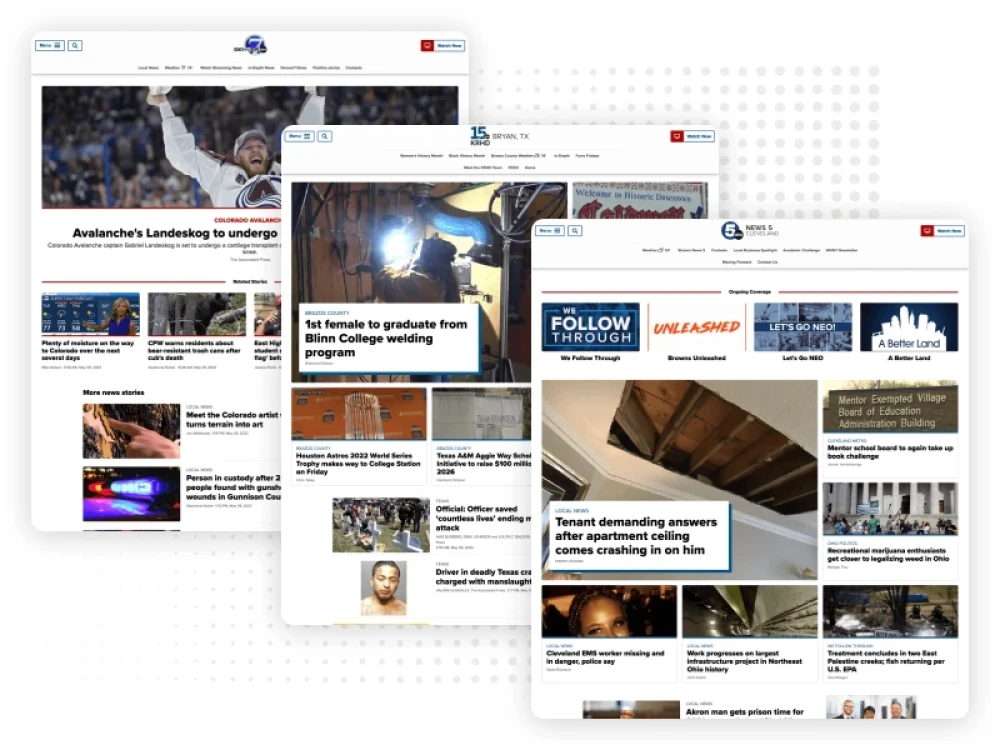
One of our reporters told me how much he appreciates our CMS. Says it’s the best he’s ever used across multiple stations and station groups.
Why it’s essential:
- Ensures consistent publication cadence and timely releases without manual intervention.
- Facilitates embargoes, coordinated campaigns and global rollouts.
Measurable success criteria:
- Support timezone-aware scheduling, recurring rules, dependency chains and pre-publish checks.
- Provide notifications and rollback paths for scheduled releases.
Example:
E.W. Scripps uses automated scheduling and workflows to publish breaking news and video across multiple stations. (Read the E.W. Scripps case study below.)

Personalization & audience targeting: Deliver relevant content to segments
Definition:
Rules-based and ML-driven targeting that adapts content by user segment, geography, device or behavior.
Why it’s essential:
- Increases engagement and retention by surfacing relevant stories and recommendations.
- Supports regional variants and brand-specific homepages.
Measurable success criteria:
- Support segment definitions, A/B tests and personalization rules with privacy controls.
- Allow localized homepage variants and cache-aware personalization for performance.

Example:
Univision localizes homepages for U.S. and Mexico audiences, improving relevance across markets. (Read the Univision case study below.)

SEO tools: Make breaking and evergreen content discoverable
Definition:
Built-in metadata management, canonical handling, performance optimizations (Core Web Vitals), sitemap generation and structured data support.
Why it’s essential:
- Improves organic reach and ensures stories appear prominently in search results immediately after publication.
Measurable success criteria:
- Provide canonical URL control, automated sitemaps, schema markup helpers and performance-first templates.
- Track Core Web Vitals and surface remediation guidance.

Example:
POLITICO uses built-in SEO capabilities to help breaking stories rank promptly; Brightspot emphasizes Core Web Vitals performance in platform design.

Analytics & real-time insights: Make data-driven editorial decisions
Definition:
Live dashboards, integration with analytics platforms and story-level engagement metrics.
Why it’s essential:
Lets editors prioritize coverage and distribution based on real-time audience behavior.
Measurable success criteria:
- Provide per-story metrics (views, engagement time, referrers), real-time dashboards and event-driven alerts.
- Integrate with common analytics tools (e.g., Google Analytics) and export data for newsroom tools.
Example:
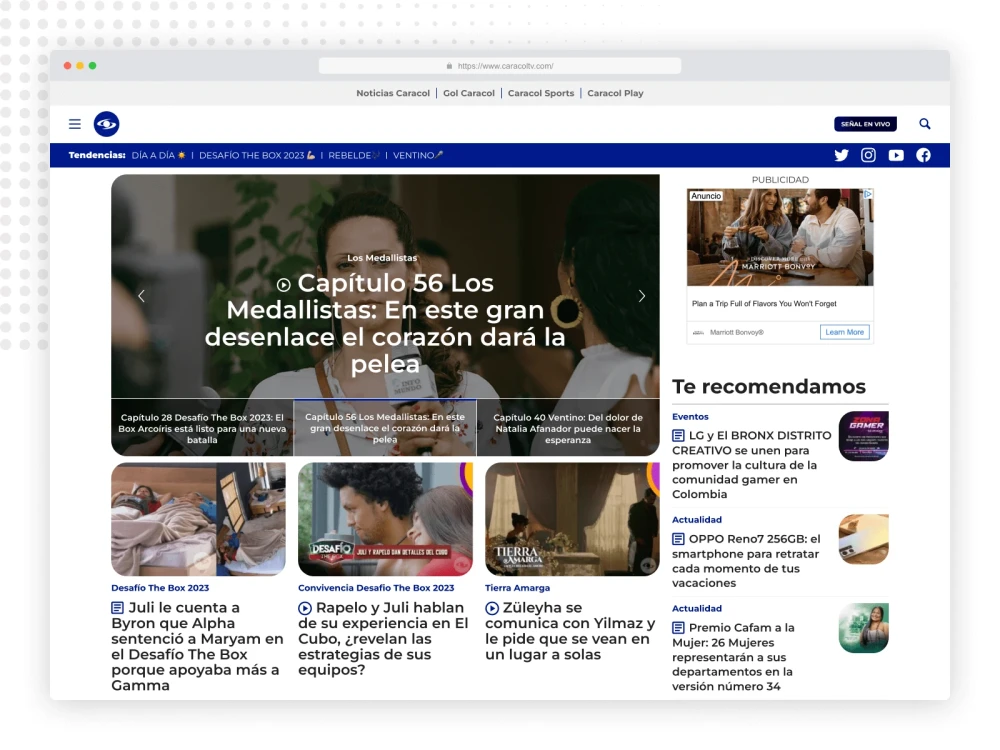
Caracol TV reported a 20% traffic increase within a week of moving to Brightspot; other customers use Google Analytics integrations to inform editorial strategy.
Monetization & paywall support: Flexible revenue controls tied to content
Definition:
Metered and dynamic paywalls, subscription management integrations and content gating controls.
Why it’s essential:
Enables publishers to optimize subscription revenue while managing access to premium content.
Measurable success criteria:
- Support dynamic rules, AB testing of meter thresholds and tight integration with identity/subscription services.
- Provide analytics on conversion funnels and revenue impact.

Example:
The Chronicle of Higher Education uses Brightspot’s dynamic paywall to adapt subscription settings based on reader behavior.
Conclusion
These 11 features form a practical checklist for any news or media publisher evaluating a CMS. Together they enable speed, scale, editorial control, audience relevance, and revenue flexibility. Where possible, test each capability against measurable success criteria—latency, RPS tolerance, archive completeness, personalization lift, and conversion rates—to validate a platform against real newsroom needs.
A CMS supports multi-channel distribution by providing single-source content, channel-specific renderers (web, app, social), and export APIs (JSON/RSS/newsletter) so an editor publishes once and the system delivers everywhere (see this Los Angeles Times case study as an example).
Validate peak requests/sec handling, CDN edge latency, cache-hit ratio and failover behavior. Brightspot-observed example: 37M requests in one minute during an Election Night DDoS while the site stayed live.
Integrate AI with human-in-the-loop controls, provenance metadata, confidence thresholds and auditable suggestion logs. Use AI for drafts, SEO snippets, transcripts and translations but require editor approval before publish.
Measure segment-level engagement lifts, repeat visit rates, click-through to recommended stories, and retained readers over time; use A/B testing to isolate personalization impact.